Behavioral Regression After LLM Swap or Fine-Tune
Hidden model changes can break production systems without triggering alerts.
An LLM swap or fine-tune can degrade production behavior without causing an error, a crash, or an obvious alarm. Detecting that regression requires more than checking whether the intended task improved. It requires a structured comparison of the old and new models across the capabilities, output contracts, safety boundaries, and agent behaviors that the change was never meant to touch.
Why a model change is not a contained event
Changing a refund classifier feels like a contained decision because the intended improvement has a narrow scope. A deliberate fine-tune can sharpen classification while degrading arithmetic, instruction following, code, or out-of-domain reasoning. An invisible provider-side update can alter production behavior without any change by the team operating the system. Both kinds of change affect the behavioral contract that the application depends on.
The OpenAI GPT-4o sycophancy incident in 2025 illustrates the second trigger. A provider-side weight update changed how the model behaved in production, and the changes showed up within days of shipping. Provider-hosted models can change without a version change, so their behavior can change even when the application stays the same.
That distinction matters because downstream components depend on more than a model’s ability to complete its main task. They also depend on how it follows instructions, shapes outputs, refuses requests, and uses tools. A change to the model can disturb any of those dependencies while requests continue to return successfully. The scope of the intended improvement therefore cannot define the scope of regression detection.
What silent regression actually looks like in production
Neogen Media’s incident report documents a model version bump behind an inference gateway that left three subordinate agents dark for six days. The four-agent mesh consisted of JARVIS, Taurus, Kiara, and Neo. Throughout the outage, health checks stayed green. The system’s checks failed to distinguish the agents’ absence from normal operation.
The banking case shows a different route to discovery. A model returned a valid string, but its casing broke downstream routing, so tickets were silently discarded. The output parsed without error and passed a semantic judge. A regression test, rather than human observation, exposed the mismatch between a semantically acceptable answer and the exact contract the routing script required.
The longitudinal production study documented in arXiv:2606.14589 places these incidents within a recurring class of failure. Over an eight-week window, roughly 70% of silent failures were caught by human observation. Its retrospective audit found no ex-ante prevention but substantial regression blocking. Systems can continue answering, routing, or reporting success while their outputs are wrong, and they can also appear healthy when expected work never runs.
Why traditional error monitoring is structurally blind to these failures
Conventional observability measures operational health through signals including latency, error rate, token count, and retry count. These signals establish whether requests are running and how resources are being used. They do not establish whether an answer is correct or whether a downstream task completed. A valid response can therefore pass every operational check even when its behavior is wrong. This is a mismatch between the property being measured and the property that failed.
The banking casing bug makes that distinction concrete. Parsing established that the output was a valid string, while the semantic judge accepted its meaning. Neither test showed that the string met the routing contract. Pandey’s study found that accuracy remained flat across five evaluation windows while output diversity collapsed by a factor of more than six.
The longitudinal research calls the most deceptive variant fail-plausible. In this mode, the model converts failure into a fluent, confident, false narrative delivered to the user. That is worse than a gray failure in cloud infrastructure in a specific sense. Instead of merely withholding a clear failure signal, it supplies an apparent explanation that misrepresents what happened. Monitoring can then receive a false account of success, rather than just an incomplete account of failure, which makes behavior-specific evaluation necessary.
The capability dimensions a model swap was never meant to touch
Capability drift is the first part of a model change’s surface area. General reasoning, arithmetic, instruction following, and code quality can degrade while the narrow target task improves. These losses are easy to miss precisely because they concern abilities outside the purpose of the change. Their detection requires comparison on capabilities that a task-specific holdout was not designed to measure.
Format and output contract regression concerns a different dependency. Changes to casing, schema validity, JSON structure, or field names can break consumers that require exact output. Safety regression, in turn, concerns boundaries. A fine-tune can weaken safety training, allowing more successful jailbreaks, prompt injection that bypasses the system prompt, lower refusal rates, or training-data leakage on trigger phrases.
Tool-call and agentic behavior regression extends the surface area across multi-step execution. A model change can alter tool selection, argument construction, or the sequence of steps. MAST (Cemri et al., 2025) identifies three structural categories of multi-agent failure, namely system design issues, inter-agent misalignment, and task verification failures. Its accompanying MAST-Data contains more than 1,600 annotated execution traces, while the taxonomy itself came from a smaller sample.
These dimensions are largely orthogonal. Even when reasoning and safety scores stay the same, output casing can break a routing script. Likewise, an agent can return valid JSON even when it chose the wrong tool. Each dimension needs its own detection strategy because success on one provides little evidence about the others.
The four-set evaluation contract that covers the full blast radius
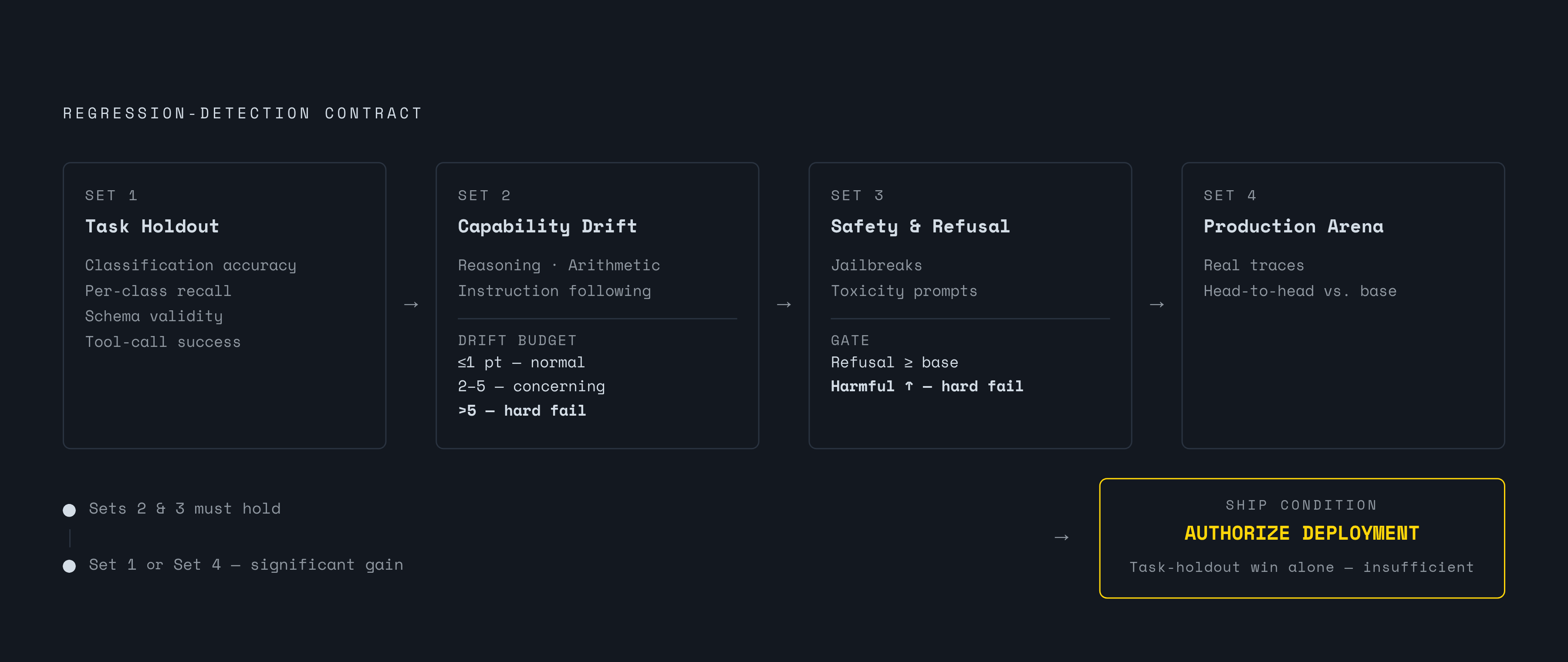
The evaluation contract compares the old and new models through four distinct sets. Both models must face the same contract, examples, rubric, and judge in the same week. This pairing makes the change in behavior the object of measurement. The candidate’s score alone cannot show whether a fine-tune made the system better or just did well on a test that favored it.
Set 1 is the task-specific holdout, drawn from a held-out partition of the curated data. Its rubric follows the task, including classification accuracy and per-class recall, faithfulness and task completion for generation, or schema validity and field-level accuracy for structured output. Agentic use requires tool-call success and argument correctness. The base model must receive the same evaluation, because the fine-tune’s value is the delta. This holdout establishes the floor.
Set 2 is a frozen capability drift suite covering broad knowledge and reasoning, commonsense inference, arithmetic, instruction following, and domain-adjacent examples. The custom examples cover capabilities the change was never supposed to touch. Run the suite against the base and candidate before and after the change. The drift budget is explicit. Up to one point is normal noise, two to five is concerning, and over five on any benchmark is a hard fail regardless of task gains.
Set 3 is the safety and refusal set, using jailbreaks, toxicity prompts, and harmful instructions against both models. The candidate’s refusal rate must be at or above the base model’s rate. Any measurable increase in harmful completions is a hard fail. Safety belongs in the contract even when changing it was never the goal.
Set 4 is the paired production arena, using real examples from traces in a head-to-head comparison. It detects candidates that win on curated data but lose on the wider range of production inputs. The ship condition requires sets two and three to hold and either set one or set four to show a statistically meaningful gain. A task-holdout win alone does not authorize deployment.
Where the eval gate lives in the development workflow
The contract becomes a gate only when it runs automatically on every model change and blocks unacceptable regressions. A manual evaluation before launch is a snapshot. Fast unit evals belong in CI, where they can assert that a router selected the correct branch, tool output parsed as valid JSON, or retrieval returned a document above a relevance threshold. These checks catch failures to meet the exact contract that an LLM-as-judge cannot reliably spot. A GitHub Action can run the evaluations on every pull request and block merges below a configured quality threshold.
Production tracing shows what happens in actual use so those tests can check for it. Every request should emit structured spans containing prompts, model, tokens, latency, tool calls, and quality scores, using distributed tracing as baseline infrastructure. Observability establishes what the agent did, while evaluation tests whether that behavior was correct. Benchmarking also measures what the model itself can do. Each of these three layers does a different job, so each is needed.
The longitudinal study gives a concrete reason to connect production evidence back to deployment gates. Its retrospective audit found that 87% of incidents were blocked by regression audits, while none were prevented ex-ante. That finding establishes the value of turning discovered failures into repeatable checks. The workflow therefore needs both a pre-deployment gate and a production feedback loop that strengthens it.
The objection: standard benchmarks already cover this
Benchmarks including MMLU, GPQA Diamond, BFCL, and tau-bench help establish whether a candidate remains in the same capability range as its predecessor. They provide a common basis for comparison beyond a team’s curated task data. That makes them necessary inputs to capability drift detection and appropriate components of Set 2. The objection is fair because a regression in the model can affect many downstream tasks.
A standardized benchmark measures the model under the benchmark’s conditions. Strong AgentBench or WebArena performance does not establish compatibility with a particular system’s tool sequences, output formats, and routing logic. The banking casing bug illustrates the gap. Semantically correct, well-formed text was still wrong for the consumer receiving it. Detecting that failure required a system-specific regression test.
MCP Security Bench research adds a more surprising limit. It found that models with stronger performance were more vulnerable to MCP-specific attacks because of their strong tool calling and instruction following capabilities. A higher benchmark score therefore does not show that a model swap is safer. Standardized benchmarks should not be abandoned, but retained as one part of the four-set contract, supported by custom datasets, trace-based evaluation, and tests built from real failures.
Building a regression detection habit that outlasts the next model change
Production traces that fail an online scorer should be converted automatically into cases for the suite. Once encoded, a discovered failure can be tested at the CI gate. The suite becomes a record of the system’s actual failure modes.
That record depends on a reproducible baseline. Prompts and model versions must be pinned and versioned so that pre/post comparison has a stable starting point and rollback is a minutes-long operation. The capability drift suite and production arena should also be updated after every incident. Freezing examples controls the comparison while allowing the contract to grow as the system reveals new dependencies.
Neogen Media’s presence checks explain why this practice must extend beyond watching for errors. The jobs simply never ran, so failure monitoring had no errors to detect. A behavioral contract checks both whether a component was present and whether the expected work happened. The durable posture is therefore to compare before deployment, evaluate during operation, and turn failures into tests afterward. That is how the next model change inherits the lessons of the last one instead of relying on another fortunate human observation.