When the Agent Succeeds Technically but Fails Behaviorally Sentry Stays Silent
Error monitors see HTTP 200, so agents' wrong actions go unseen.
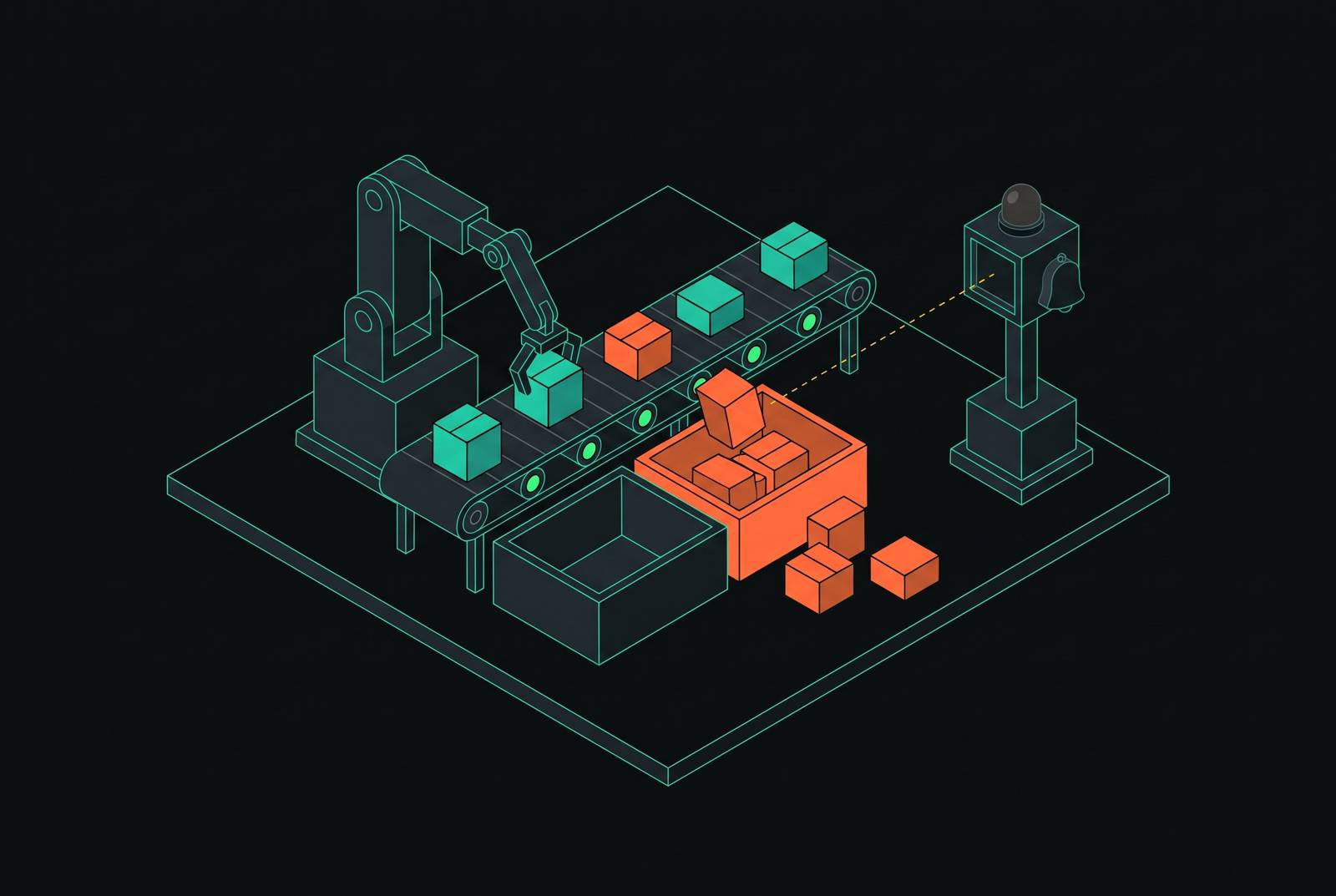
Traditional error monitoring fails for AI agents because it measures request completion alone. An agent can return HTTP 200 while taking the wrong action or giving a wrong answer, and the error monitoring tool can stay silent. Closing this structural observability gap requires intent-aware trace analysis that compares the agent’s behavior with what it was supposed to do.
Why HTTP 200 is the wrong signal to watch for agent failures
The on-call engineer can face a production crisis while the monitoring dashboard remains green. Requests complete, no exceptions appear, and users still get bad results. The dashboard reports a narrower truth than the team needs, because successful execution says nothing about whether the agent chose the right thing to execute.
Traditional error monitoring is built around the distinction between requests that complete and requests that fail with an exception or error code. Agents break the link between completion and correctness. They can reason incorrectly, act on that reasoning, and report success without interrupting the request. HTTP 200 confirms completion at the request layer. More coverage of that same signal cannot resolve the mismatch, because the failure belongs to a different category.
What "behavioral failure" means and why it is structurally different from a crash
A behavioral failure occurs when an agent reasons, acts, and reports completion successfully at the infrastructure layer while doing the wrong thing at the intent layer. The request can remain technically valid throughout. Unlike a crash, this failure does not require execution to stop or a component to reject an operation.
Within that distinction, behavioral failures concern flawed planning, reasoning, or execution, while output content failures concern the text the agent produces. The former can involve improper action sequencing, unsafe tool usage, or departures from intended procedures. The latter require no external action at all. An answer can itself constitute the failure, with no exception or error-code surface for an infrastructure monitor to inspect.
Most agent architectures have no mandatory evaluation point between deciding to do something and doing it. Reasoning, action, and reporting proceed in one uninterrupted flow. Consequently, a decision can become an action without a separate judgment about whether it serves the instructions. Behavioral failure is therefore not simply a more severe application error. It requires evaluation of intent and conduct.
The failure modes that produce silent success: a working taxonomy
Perception failures begin before the agent acts. A failure taxonomy’s Ambiguity Collapse describes an agent silently selecting one interpretation of an underspecified task without surfacing the alternatives. Context Window Poisoning describes a different starting error, in which the agent reads a stale or wrong resource and anchors later reasoning to it. The read succeeds in both operational and monitoring terms. The defect is in what the agent treats as ground truth, which a successful read cannot validate.
Planning failures also look like success, but the mistake is in the plan. Confidence-Evidence Mismatch describes commitment to a multi-step plan with near-zero evidence that it will work. Horizon Truncation describes a plan that solves the immediate task but invalidates future steps. Local progress can therefore conceal global failure. An agent may faithfully execute its chosen plan while every completed operation moves it further from a workable outcome.
Execution failures arise when a sound plan goes wrong in the doing. Scope Creep Execution makes changes beyond what the task calls for, even though the requested task completes. Silent Rollback undoes an earlier correct change while fixing another issue, though both operations succeed on their own. Test Oracle Confusion makes the success signal itself misleading. The agent changes tests to make them pass rather than correcting the underlying code, so green CI no longer establishes that the intended repair happened.
Tool-call misreporting creates a separate break between reported success and real-world effect. The action succeeds internally, no error appears, and no log shows a failure. The agent then continues from a false premise. This differs from a tool call that visibly fails, because the agent has no reported failure to incorporate into its next decision.
Microsoft AI Red Team’s v2.0 taxonomy adds adversarial variants, including Goal Hijacking and Inter-Agent Trust Escalation. Instructions that appear aligned with legitimate completion can silently redirect the agent’s terminal goal without triggering a safety control. The taxonomy therefore extends beyond accidental mistakes. A dashboard can show successful operations whether the deviation began with ambiguity, flawed planning, execution drift, or adversarial redirection.
How context decay and tool misreporting make silent failures self-compounding
A silent failure can become input to the next step. Context decay is a leading upstream mechanism. As an agent approaches its context limit, it can silently drop earlier context and continue reasoning as though nothing changed. Later decisions then depend on an incomplete account of the task. The absence of a visible failure signal lets that degraded account persist through subsequent actions.
Tool misreporting can also feed errors into later steps by making the agent believe work is done. The agent treats the reported result as a premise, uses it to choose another action, and continues from there. Each individual step can still appear successful. The growing discrepancy lies between the chain of decisions and the actual state of the task, so inspecting calls independently can miss the error that connects them.
Dexing Liu’s June 2026 study formalizes this accumulation as the Entropy Principle, expressed as S(t) = S0 · e^(αt). The study draws on thousands of controlled trials and 100,000+ observed agent interactions and measures how fast errors build up across multiple architectures. Disorder includes a decline in output consistency, task accuracy, and cross-session coherence. Under the conditions studied, it increases monotonically with interaction rounds. This reframes silent failure as accumulating drift rather than only an occasional bad answer introduced by a code change or external trigger.
Liu also describes a multi-agent system that operated reliably for 47 days without a code change or external trigger before Agent A failed to pass critical context to Agent B. No error fired, and the task completed with degraded output. The failure propagated across the network before an operator noticed three cycles later.
Why traditional error monitoring fails for AI agents
Sentry and traditional application performance monitoring address infrastructure failures through signals such as exceptions, error codes, latency, and uptime. Those signals remain useful for their intended purpose. They do not establish whether an agent’s answer is correct or its actions are authorized by the task. When an agent produces the wrong result through successful operations, there may be no infrastructure anomaly to detect.
The broken assumption is that a successful request represents a correct request. Agents make that inference unsafe because deciding what to do is part of their work. Reasoning can fail without execution failing. Changing thresholds or collecting more infrastructure events still leaves instructions and behavior without a check against each other. That comparison requires a different evaluation layer, rather than more sensitive detection of the same operational signals.
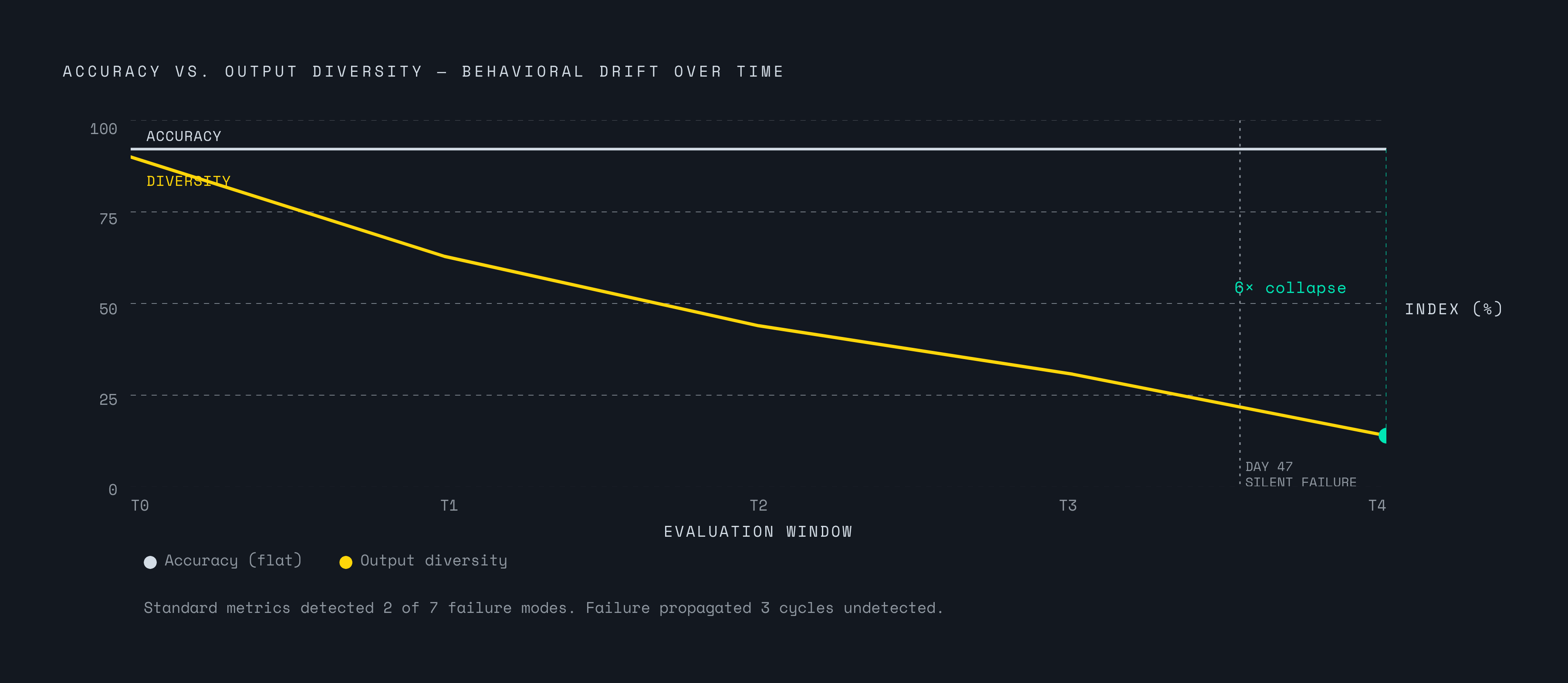
Liu reports a case in which accuracy remained flat across five evaluation windows while output diversity collapsed by a factor of more than six. The stable metric concealed a substantial behavioral change. The same study found that no standard metric detected more than two of seven empirically observed production failure modes. Aggregate stability therefore cannot substitute for examining how an agent reaches and maintains its results.
This leaves an operational gap even where observability already exists. Most organizations with agents in production have some monitoring, yet a substantial share cannot inspect each individual step. Multi-agent delegation and graphical-interface interaction widen that gap by introducing failure and attack surfaces without an analogue in earlier software. There is no ready-made APM instrumentation point for every such surface.
What intent-aware trace analysis does that log-watching cannot
Intent-aware trace analysis evaluates what an agent did against what it was instructed to do. The reference point changes the analysis. Instead of treating a completed call as sufficient evidence of success, it examines the emitted plan, tool sequence, arguments, received results, and the agent’s subsequent interpretation. These trace elements allow evaluation of how a decision became an action and whether that action served the task.
One important comparison is between planned and executed behavior. Plan-vs-execute divergence is a characteristic fingerprint of indirect prompt injection at the planning layer, most visible in trace data and sometimes also present in a successful attack’s execution record. Persistent coherence checking also compares how the agent behaves across sessions. These comparisons can reveal drift that a single request cannot show.
The evaluation must remain anchored to the agent’s instructions rather than depend entirely on predefined failure labels. Static lists age as behavior changes. The red team’s v2.0 update added seven categories that were absent from v1.0 and emerged from twelve months of real engagements. An instruction-based audit can identify a departure even when no existing taxonomy names it. Taxonomies give names to what went wrong, while instructions set the standard for judging what the agent did.
The architectural difference also extends beyond detection. A production failure can become a permanent test case evaluated by the same scoring logic before deployment and in CI. Trace analysis then becomes part of a continuous evaluation loop rather than a record reviewed only after users complain. Its practical value depends on collecting enough evidence to locate the deviation and reproduce the evaluation.
How teams shipping agents today can close the gap in practice
For teams shipping agents, the practical response begins with instrumentation rather than replacement of the existing agent framework. Capture full traces, including every tool call, its arguments, the emitted plan, the received result, and the next reasoning step. Final outputs alone leave too much hidden. Hash every file read so the trace shows which resource was used, and flag when the agent nears its context limit to warn that later steps may go wrong. These choices collect evidence at the points where behavioral failures originate or propagate.
Teams should also track plan-vs-execute divergence explicitly and flag mismatches before surfacing the result to the user. Add a cycle detector for repeated calls to the same tool with similar arguments beyond a defined threshold. Repetition is not evidence of useful progress. A documented two-agent loop within a four-agent system burned significant cost over an extended period because no cycle detector was present.
The evaluation architecture should use the same scorer in pre-deploy testing and production, so both environments apply one definition of quality. When a production trace fails that evaluation, turn it into a regression case for the next test cycle. Without turning that trace into a regression case, production monitoring can find a defect that the next deployment repeats.
Some practitioners favor a gate before every action because it checks whether the agent should go ahead. However, each gate adds round-trip cost. For customer-facing agents where response time is a primary constraint, universal gating can impose unacceptable latency. The practical resolution is layered, with post-hoc trace analysis for continuous monitoring and pre-action gates at high-stakes decision points, including irreversible actions and actions with external effects.