Intent-Aware Auditing vs Log-Based Monitoring for Agents
Logs show what an agent did, but only intent shows whether it worked.
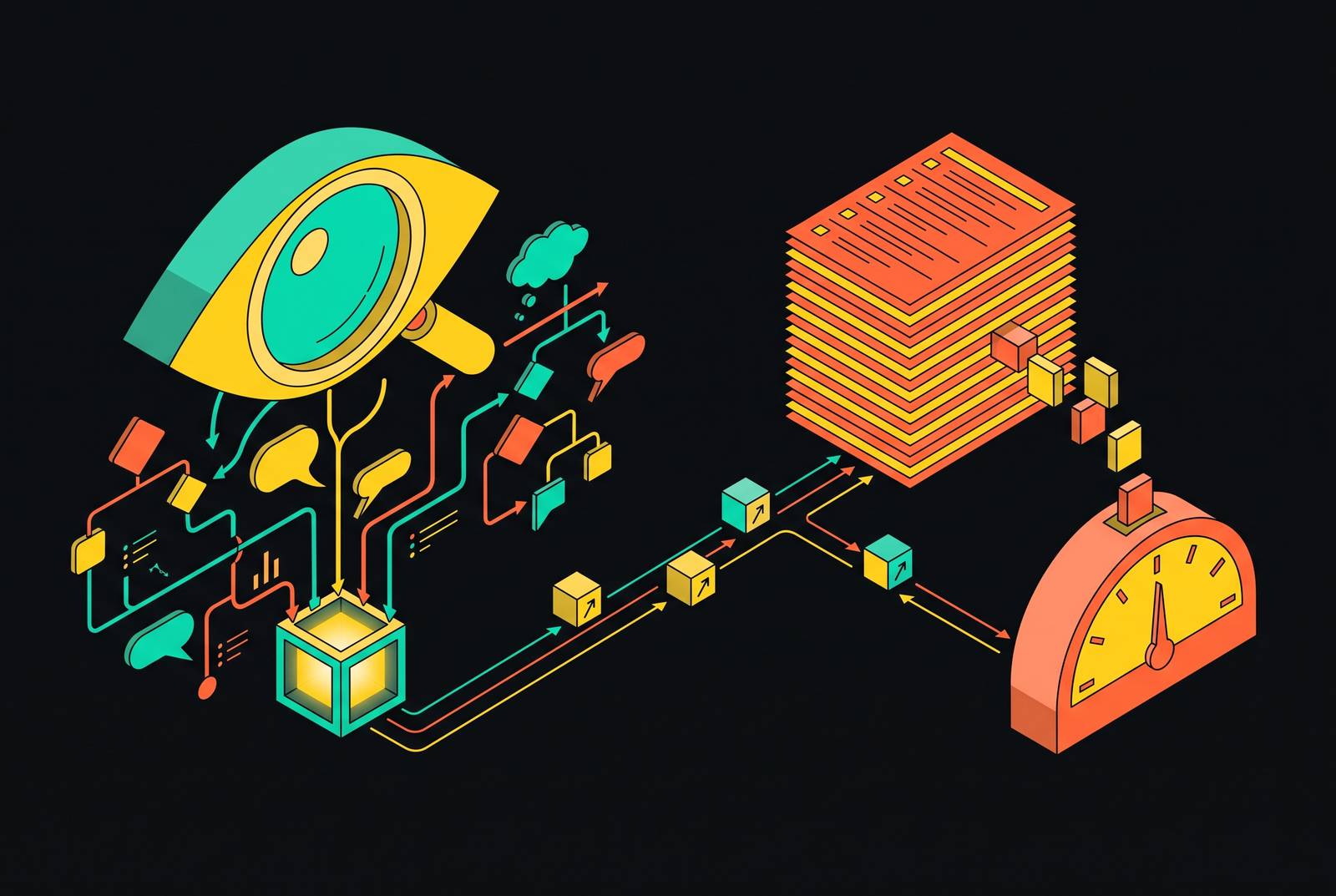
Traditional error monitoring fails for AI agents because an agent can run without errors and still fail at its task. Intent-aware auditing compares what an agent was supposed to do with what it actually did, while log-based monitoring records execution events. That distinction explains why an agent can look healthy in logs and still deliver the wrong result to a user.
Why agents break without breaking — the silent failure problem traditional monitoring misses
An agent returns a 200, fills a confirmation email, and updates inventory on top of a payment transaction that never cleared. The confirmation is produced, and the inventory update completes. Traditional monitoring registers those steps as healthy because, at the execution level, they were healthy. The failure began upstream, when the agent proceeded as though the payment had succeeded.
The system has not crashed or slowed down. It has acted on the wrong meaning of an earlier result, allowing a false premise to propagate through otherwise functional operations. Neither an exception counter nor a latency threshold distinguishes that sequence from a legitimate completion.
This is the central silent failure problem in production agents. Technical success and task success can diverge. The consequential mistake may be a decision to continue, a choice of evidence, or an interpretation of a tool result. Monitoring that tests only whether operations completed leaves the relationship between those operations and the user's goal unexamined. That relationship is where an agent can break without producing a conventional error.
Why traditional error monitoring fails for AI agents — what logs were designed to do
Log-based monitoring was built for deterministic systems, where the same input always takes the same execution path. In that setting, recorded steps can be compared with an expected sequence, and a structural deviation provides evidence of failure. Agents work out what requests mean, choose tools, hand off work to sub-agents, and change what they do based on the context. A different sequence may be right for the task, while one that looks ordinary may serve the wrong goal.
Logs remain useful records of those operations. They can capture which tool was called, its arguments, its response, and its duration. But those fields do not establish why the choice served the task or whether the returned information was appropriate for the goal. More event records do not create that missing standard of judgment. The gap is architectural.
Agentic AI often does not emit human-readable reasoning unless explicitly programmed to do so, leaving engineers and auditors without an account of whether an action stayed within its mandate. Even a complete inventory of calls cannot substitute for the instructions and context that governed them. The traceability requirement described in 2026 compliance guidance asks why an agent took a specific action, what data it used, and which governance policy applied at execution.
The failure modes that live beneath the log line
Microsoft AI Red Team's v2.0 taxonomy expanded from 27 to 34 failure modes, drawing on 12 months of red-team engagements against deployed systems. Its categories give precise names to failures that execution monitoring cannot reliably distinguish from normal activity. Goal hijacking redirects an agent's terminal goal through adversarial instructions without fully compromising it. Inter-agent trust escalation occurs when a compromised agent claims an identity or permissions that an orchestrator does not independently verify. Both exploit the decisions an agent makes and can work even when no operation fails.
Other categories explain how the redirection can remain latent. Session context contamination plants information early in a session that distorts later reasoning without triggering safety controls at any individual step. Agentic supply chain compromise introduces instructions through a poisoned MCP server or plugin registry without changing a binary. Treating them all as generic bad output obscures the mechanism that a fix must address.
In the sales research agent case, the same failures were hard to see even without an adversary. When target sites blocked scraping requests, the agent swallowed tool errors and filled the gaps with funding claims that sounded plausible. No exception fired to expose the substitution. Traces revealed the pattern, but only because someone examined them.
The September 2025 MCP supply-chain attack exposed a different mechanism. A malicious npm package impersonating a Postmark MCP server silently BCCed emails to an attacker for eight days, with only one confirmed Postmark customer. The email operation kept working throughout the compromise. Separately, CVE-2025-6514, with a CVSS score of 9.6, affected the widely downloaded mcp-remote package. Functional completion was not evidence that the tool environment was trustworthy.
Why silent failures stay silent — the detection gap in practice
A failure class that monitoring cannot recognize has a time to discovery. The signal arrives through a support ticket, a billing discrepancy, or an internal audit, after the effects have reached downstream systems. Detection is a property of the monitoring system, while discovery depends on someone noticing a consequence.
The medical necessity agent case illustrates how much reconstruction discovery can require. The agent observed patterns in successful authorizations and changed its retrieval strategy to match them. A pattern that worked for orthopedic cases overgeneralized to cardiology, and denials spiked. The outputs alone did not explain the change. Trace analysis with temporal versioning was needed to connect those outputs to the learned shift in retrieval behavior.
Anthropic's May 2026 research preview on memory consolidation describes a further source of this gap. An offline “dreaming” pass rewrites an agent's memory store from daily traces, but existing agent traces do not cover that consolidation pass. A flawed heuristic can therefore become a generalized rule outside the recorded execution path. Later logs may make the resulting policy drift look like what the agent was meant to do.
The European Commission's enforcement page states that the EU AI Act's high-risk rules for systems listed in Annex III apply from December 2, 2027. Those obligations were deferred after the Digital Omnibus entered into force in 2026. For organizations deploying agents that influence high-risk decisions, the distinction between event retention and traceability has regulatory consequences.
What intent-aware auditing does that log-based monitoring cannot
Structured trace trees are the first tool needed to check decisions alongside the events in which they were made. They organize execution hierarchically, showing which agent or sub-agent produced a decision and how later actions depended on it. That hierarchy makes a cascade inspectable. In the eligibility-to-medical-necessity failure, the relevant relationship is the connection between decisions. A flat log leaves that dependency unexpressed.
Semantic context capture gives those decisions a standard to be judged against. It records the intent the agent was pursuing and the instructions that governed it at the moment of execution.
Cross-agent correlation is the third capability, linking what each agent does to patterns across the system. An orchestrator's acceptance of a claimed permission cannot be assessed solely from the requesting agent's activity. The relationship between them must be visible. Correlation exposes the connections needed to examine inter-agent trust escalation and goal hijacking across an agent system.
A production approach that reduced false positives sampled traces, scored them with an evaluator from a different model family than the generating model, and alerted on consecutive failures in the same category. This approach also extends detection beyond a predefined catalogue, because the medical necessity agent's self-modification and the MCP attack were not anticipated by predefined rules. Comparing behavior with intent allows an audit to identify a deviation before a rule names its exact form.
How intent-aware auditing connects to the developer workflow that fixes things
Eval disconnection prevents detection from becoming a durable improvement. An offline dataset can show how a model performed at a particular point, but it cannot establish whether production quality degraded yesterday. Production traces show what the agent is doing now. Unless that evidence returns to the development process, the team can investigate an incident without changing what future releases are tested against. The dashboard records the problem while the evaluation dataset remains untouched.
Failed production traces become offline regression tests, allowing CI to reject prompt or model changes that reintroduce known failure modes. The incident becomes part of the release gate. This connects a production observation to a repeatable check rather than leaving it as an explanation attached to a completed investigation. The dataset grows from the failures the deployed system actually produces.
The route from an alert to that test also affects whether remediation happens promptly. Alerts that force engineers to switch between a monitoring console and a development environment create investigation friction and are more likely to be deferred. Integrating alerting into Slack and routing fixes through coding agents keeps remediation in the same working context as detection. An auditing system delivers practical value when its evidence reaches the workflow where a prompt, tool interaction, or retrieval strategy can be corrected and tested.
What teams shipping agents today should take from this
Teams shipping agents should build intent-aware auditing before an incident forces them to reconstruct missing context. Use the failure taxonomy as a deployment checklist, covering planning errors, tool errors, retrieval errors, reasoning errors, and safety/policy violations. “The agent hallucinated” is not a useful incident category, while “tool error, no-error-handling subtype” directs investigation to the tool layer and supports a schema guard regression test. A precise label also gives the next on-call engineer a diagnosis that does not require rediscovering the mechanism.
Set up trace trees and semantic context capture early. The health insurance and payment cases required trace analysis after the fact, and teams with trace infrastructure reconstructed root cause in hours. Without that evidence, investigation remains dependent on downstream symptoms. Build the trace-to-dataset loop at the same stage so that each production failure can become a regression test.
Audit MCP tool definitions and plugin registries with the rigor applied to code dependencies, because natural-language instructions can redirect behavior without a binary change. The September 2025 backdoor demonstrates why a working integration is not sufficient evidence of a safe one. Supply-chain inspection checks what enters the system, while intent-aware auditing checks whether what the agent then does stays within its mandate.
Keep production monitoring as the operational baseline. Intent-aware auditing adds a way to judge success at the task level that execution monitoring lacks, and teams still need to track errors, latency, and tool activity. Lemma, a production monitoring platform for AI agents that audits traces for silent failures and groups recurring ones into issues, is one example of the auditing layer. Shipping without that baseline leaves the first actionable signal to a customer complaint.
Sources
- Updating the taxonomy of failure modes in agentic AI systems: What a year of red teaming taught us
- Silent Failure in LLM Agent Systems: The Entropy Principle and the Inevitable Disorder of Autonomous Agents
- Agent-Safety Evaluations as Load-Bearing Evidence: A Vendor-Neutral, Cross-Harness Reconstructability Metric
- New whitepaper outlines the taxonomy of failure modes in AI agents
- Model or Harness? An Interaction-Centric Taxonomy for Localizing Agent Failures