Instruction-Grounded Verification in Production Agent Platforms Compared
A comparison of which agent platforms check runs against instructions, and which only log them.
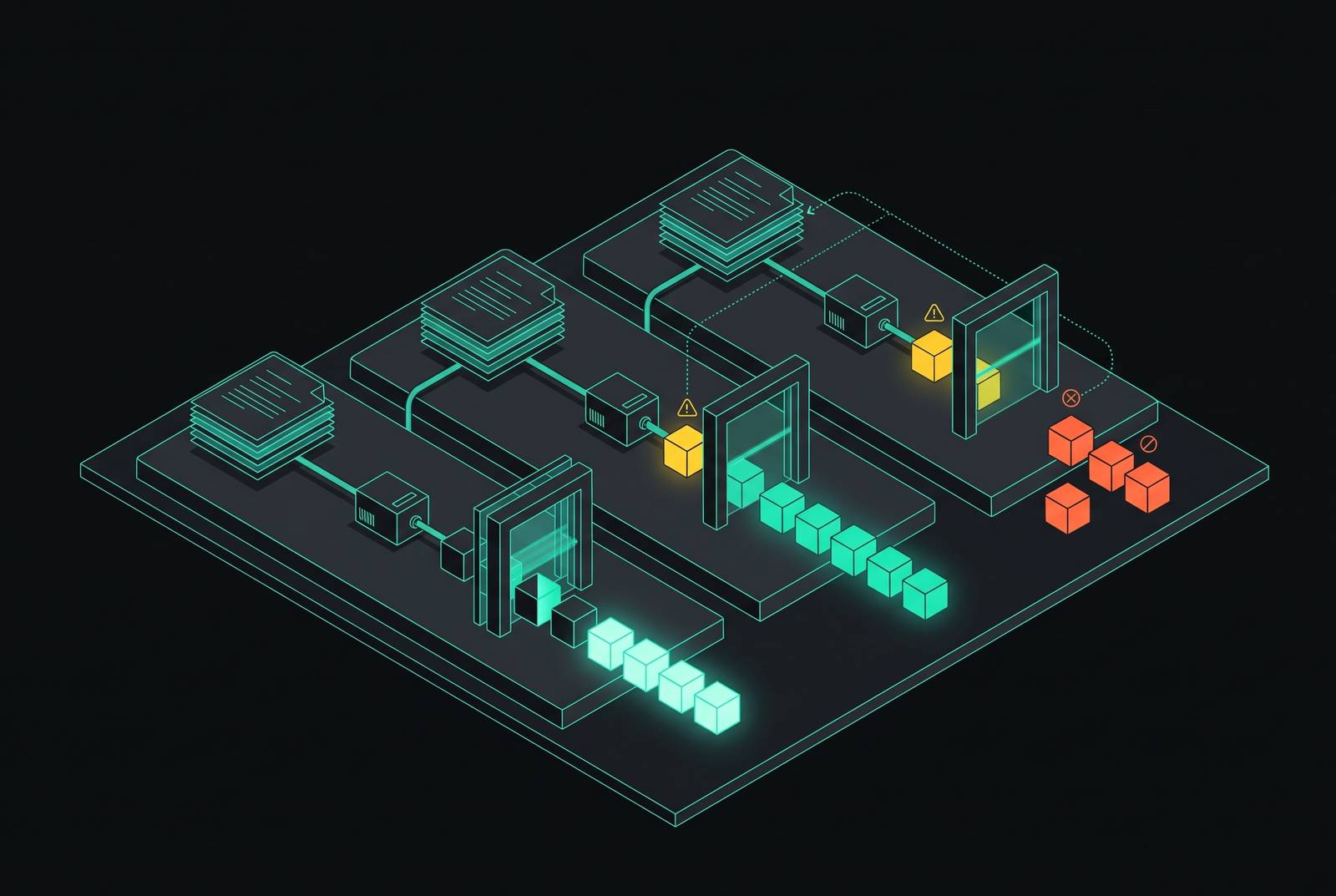
Instruction-grounded verification is intent-aware auditing for AI agents that compares execution with the instructions the agent was given, rather than relying on service health, generic quality scores, or hand-written assertions. Production platforms differ in whether they perform that comparison or only supply traces from which teams can build it. Comparing execution with instructions allows a technically successful run to be recognized as a semantic failure.
Why agents fail in ways that return HTTP success responses
A logistics workflow can complete successfully while routing work to the wrong queue. The request returns an HTTP success response, the output has the expected structure, and the workflow finishes without an infrastructure error. Yet the routing decision violates the task. In semantic failure, the agent succeeds at executing an action but fails at doing what it was instructed to do.
The same gap appears when an agent invents a policy citation or produces a technically valid answer that is wrong for the request. Uptime and latency monitoring cannot tell these outcomes apart from correct ones because neither signal shows what the agent was supposed to do. Research on cloud systems calls this pattern gray failure. The system is failing while its monitoring reports health, leaving downstream users or business processes to expose the discrepancy.
The failure is structural when an agent has authority to act but no runtime mechanism compares its actions with its instructions. A successful response can then become a misleading reassurance. Checking such a system requires a different question from whether the request succeeded, namely whether the agent did what it was supposed to do.
How do platforms audit agents against what they were supposed to do?
Instruction-grounded verification uses the agent’s declared instructions as the specification against which execution is judged. For a support agent, those instructions may have routing rules, refund policies, and escalation thresholds. They define the task and its permitted boundaries. An audit that ignores them can describe a successful tool call without recognizing that the agent should have escalated instead.
Conventional checks answer narrower questions. Uptime and latency reveal infrastructure problems, while schema validation can establish that a tool call is structurally acceptable. Hand-written assertions test for conditions that a team thought of ahead of time. Those assertions can catch known failures, but what they catch depends on how well the team predicts the ways an open-ended system will stray from its task.
Generic quality metrics do not close that gap. Confidence scores, BLEU, and semantic similarity measure properties that need not correspond to policy compliance. An answer that sounds right can still break an escalation rule. Instruction-grounded verification instead asks whether the observed behavior satisfies the instructions for that execution, making the instructions the ground truth rather than treating a separate test harness as a substitute.
This distinction separates deployment configuration from an executable specification. A platform may store and pass along a system prompt without ever using it to check the actions that follow. In that case, the policy remains a documented assumption. It becomes a governance control only when a mechanism checks whether behavior matches the permitted task.
The six layers where agent behavior can diverge from instructions
Tool-call and schema drift is a common entry point into failure. The agent selects the right tool but supplies arguments drawn from the wrong context, so structural validation accepts the call. Detecting it requires comparing the arguments with the stated goal.
Retrieval and context quality make up a second layer because bad inputs can make the reasoning that follows seem sound. When Sherlocks looked at production incidents, it found upstream retrieval failures in most multi-layer failures. Stale or malformed context feeds plausible but incorrect decisions downstream. Instruction-aware checking therefore needs to check the context used for the task as well as the final answer.
Memory and long-chain drift carry that problem from one step to the next. An early error written into state feeds into later decisions, so it is hard to explain the final result without the full sequence. Planning and decomposition create a distinct mismatch. An agent can execute every step correctly while pursuing the wrong subproblem, and the plan’s inadequacy becomes visible only when compared with the original instruction.
Permission boundary violations occur when an available tool accepts an action that the agent was not authorized to take. Observability failures form the sixth layer, where no detection mechanism exists and a support ticket, billing discrepancy, or complaint becomes the first signal. These incidents have the longest resolution times among the categories described. Across all six layers, service health alone cannot establish whether the agent respected its task, context, plan, or scope.
How the absence of instruction-grounded checks compounds in multi-step workflows
In a single-step interaction, an incorrect output can remain a contained event. In a multi-step workflow, the output at step two becomes the input at step three and then contributes to state at step four. Each subsequent action inherits the earlier error. By step fifteen, the final answer may be entirely wrong without showing where the error began.
This is cascading state corruption. A minor validation slip can contaminate memory across the chain while later steps remain internally consistent with that corrupted state. Detection timing therefore changes the diagnostic burden. If a complaint is the first signal and intermediate context was not captured, the team lacks the sequence needed to locate the original divergence efficiently.
Microsoft’s AI Red Team described memory poisoning in its June 2026 updated agentic failure taxonomy as an existing failure mode amplified in agentic contexts. A successful injection can propagate the bad instruction into subsequent sessions. This is the acute form of compounding. The agent’s retained state allows a single corruption to influence behavior beyond the interaction in which it began.
Cost drift shows the slower form. A fintech startup’s fraud detection agent ran without runaway alerts while its monthly bill rose sharply quarter-over-quarter, in large part because retry loops multiplied token consumption as more users joined. No single request was anomalous enough to expose the aggregate pattern. Cost alone would not prove an instruction violation, but the case shows why individual execution records are insufficient. Observability describes activity, while instruction-grounded evaluation establishes whether that activity remained consistent with the task.
What production agent platforms actually do to check behavior against instructions
The useful comparison separates instrumentation from judgment. Some platforms treat instructions as deployment configuration, some provide traces for inspection, and a smaller set actively compare execution with declared instructions. The distinguishing capability is using the instructions to detect divergence and presenting that divergence as an actionable issue.
Vercel AI SDK provides substantial instrumentation through the separate @ai-sdk/otel package. AI SDK 7 no longer includes OpenTelemetry span collection inside the ai package, so the telemetry integration must be registered explicitly. Its coverage includes a root invoke_agent span, model calls, individual steps, tool executions, and errors, with generation, TTFT, and token-count data available to OTel-compatible backends. Verification logic still has to be built on top because the SDK exposes what happened rather than deciding whether it matched the instructions.
OpenAI Agents SDK includes tracing enabled by default, with records available in its Traces dashboard without custom instrumentation. Those records cover model calls, tool calls, handoffs, guardrails, and custom spans. The limitation is the absence of a built-in mechanism that reads the agent’s system prompt and audits execution against it.
The SDK also supports an official OTel bridge through opentelemetry-instrumentation-openai-agents-v2 in opentelemetry-python-contrib. Third-party options include openinference-instrumentation-openai-agents and traceloop-sdk. These integrations change where traces can be analyzed. They do not, by themselves, supply instruction-awareness, so moving the data into another backend does not resolve the verification gap.
Mastra also needs instruction-grounded verification to be built on top. Its language-native framework has its own instrumentation layer and traces tool calls and workflow steps. LangSmith provides tracing, evaluation, and debugging across LangChain, LangGraph, Deep Agents, the OpenAI Agents SDK, and custom code. That broader evaluation support is a separate capability from tracing. It does not alone establish that an evaluation reads the original instructions and judges behavior against them.
Platforms can be judged by whether they capture instructions, context at each step, and tool arguments before execution, and compare declared plans with actions. Grouping recurring issues and using evaluations drawn from production make it possible to judge more than a single run. A platform with detailed spans but no instruction comparison supplies the evidence for an audit.
How instruction-grounded verification works at the execution level
The capture sequence begins with the declared instructions at the point of execution. Those instructions establish what the agent was supposed to accomplish and what limits applied. Next comes the full context window for each reasoning step. Saving only the final output leaves out the stale retrieval or malformed context that may explain why the agent strayed from its task.
Third, the tool arguments built before each call fires are captured. These expose the action the agent is about to request, including structurally valid arguments that contradict its goal. The fourth is the comparison between a stated plan and the action taken. Together, these capture points connect the specification, the information available, and the actual execution.
Where a framework makes a stated plan available before an action, that plan can be compared with the resulting tool call. A mismatch is an early diagnostic signal. It can reveal divergence between declared intent and execution, including patterns associated with context corruption, without relying solely on the final response.
Detection also needs a unit that teams can triage. Teams cannot keep up by reviewing every trace on its own, so patterns that recur must be grouped into issues. Alerts can then use signals such as cost per run above the P99 historical distribution, tool-call count above P99, or error rates on specific tools that are above a threshold. A rolling quality-score drop adds semantic evidence only if the score is computed against the instructions. Generic benchmark scores cannot make operational anomaly detection work as an instruction-aware audit.
Turning production failures into ongoing verification without hand-writing assertions
Production failures supply cases that a team could not reliably anticipate before deployment. Hand-written assertions need someone to think of each failure mode, write a check for it, and keep that check up to date. Real execution provides a different starting point. Once a recurring divergence is detected and grouped, it should automatically become an evaluation run against future deployments.
That evaluation is a live artifact of actual failure. Its purpose is to prevent the same defect from returning undetected after a fix ships. The instruction remains the governing specification. Production data supplies the concrete situation in which execution departed from it, giving future verification a case grounded in real use.
The resulting workflow joins detection to engineering work. It proceeds from identifying the failure and diagnosing its root cause to proposing a fix, ideally handed to a coding agent over MCP where engineers already work. Verification then tests the fix with the automatically generated evaluation. Without that last step, monitoring reports a problem but does not establish whether the change resolved it.
The logistics routing example, the fintech cost-runaway case, and support-triage errors show the different ways things can go wrong when the same comparison is missing. Better dashboards can make their activity easier to inspect. They cannot independently establish that the activity obeyed the agent’s instructions. The engineering proposition is to make those instructions a verifiable constraint on execution, then turn each detected divergence into a check on future behavior.